The agents
Seven agents. One orchestrator. One line.
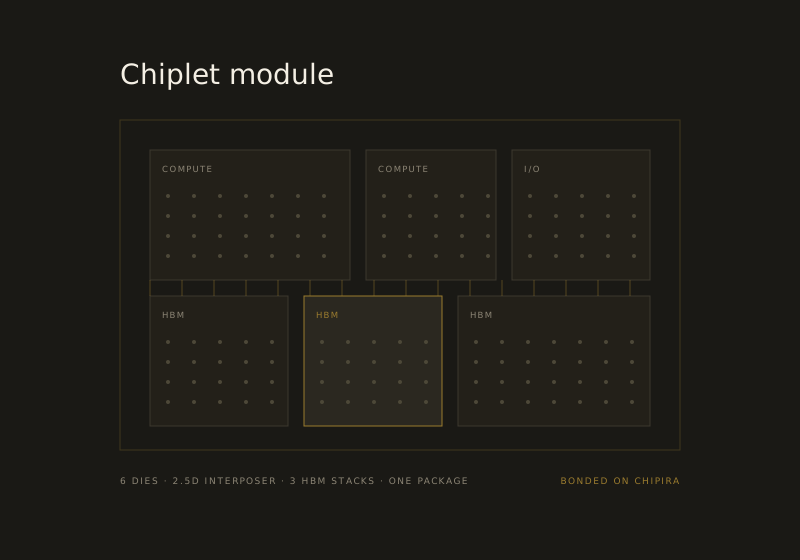
Each agent owns a step of the package flow, holds its own perception and control models, and answers to a packaging-fab orchestrator that sequences the whole line and enforces the envelope.
Why agents, not a model
A package is a sequence, not a prediction
A single large model cannot run a packaging line, because a packaging line is not one decision. It is a chain of physically coupled decisions with different sensors, different latencies, different failure modes and different consequences — and a mistake at step two only reveals itself at step six.
So Chipira decomposes it. Each agent owns a step, its instruments and its action envelope. Each is separately measurable against a baseline your engineers already trust, and separately buyable, which means a fab can adopt one and prove it before adopting the next.
The orchestrator is what makes them a line rather than a collection. It sequences, resolves contention between agents, enforces the envelope, routes every proposed move through the twin, and holds the single audit trail that spans them all.
- Separately provable — each agent has its own accuracy baseline
- Separately buyable — land on one workflow, expand across the loop
- Jointly optimised — the orchestrator arbitrates, the twin validates
- Commonly governed — one envelope, one audit trail, one identity model
The roster
What each agent owns
- 01 Place-and-Bond
Runs die-attach, flip-chip and hybrid bonding — placement accuracy, bond force, thermal profile and sub-micron alignment, held inside an approved action envelope.
- 02 Stack-and-TSV
Optimises HBM and chiplet die-stacking, through-silicon-via sequencing and known-good-die ordering so the most valuable die is never spent on a doomed stack.
- 03 Warpage-and-Defect
Senses and predicts warpage, voids, bump co-planarity and bridging, die cracks and delamination across X-ray/CT, SAM and AOI — one perception layer, not five thresholds.
- 04 Mold-and-Underfill
Controls molding, underfill flow and cure to eliminate voids and residual warpage before the package is committed to test.
- 05 Substrate-Handling
Drives robotic die, substrate and panel handling and cassette logistics, keeping particles and mishandling out of the bond.
- 06 Test-and-Bin
Runs final and system-level test and binning, closing the loop between what was bonded and what actually works.
- 07 Yield-and-Ramp
Fuses defect root-cause, tool health and yield analytics into the decisions that shorten a ramp from quarters to weeks.
In detail
Three agents, up close
Agent 01
Place-and-Bond
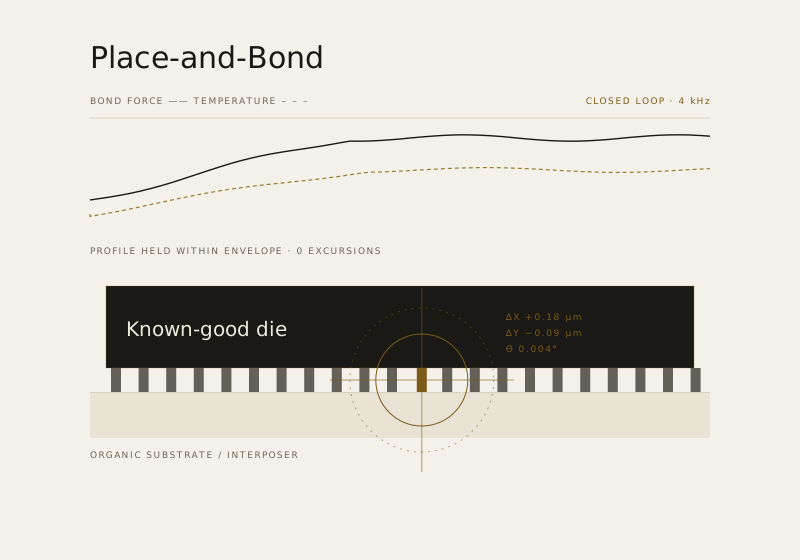
Controls die-attach, flip-chip and hybrid bonding: placement accuracy, bond force, thermal profile and sub-micron alignment. It reads alignment metrology and force and temperature telemetry continuously, corrects inside the envelope, and stops the tool rather than commit a bond it cannot vouch for.
Agent 03
Warpage-and-Defect
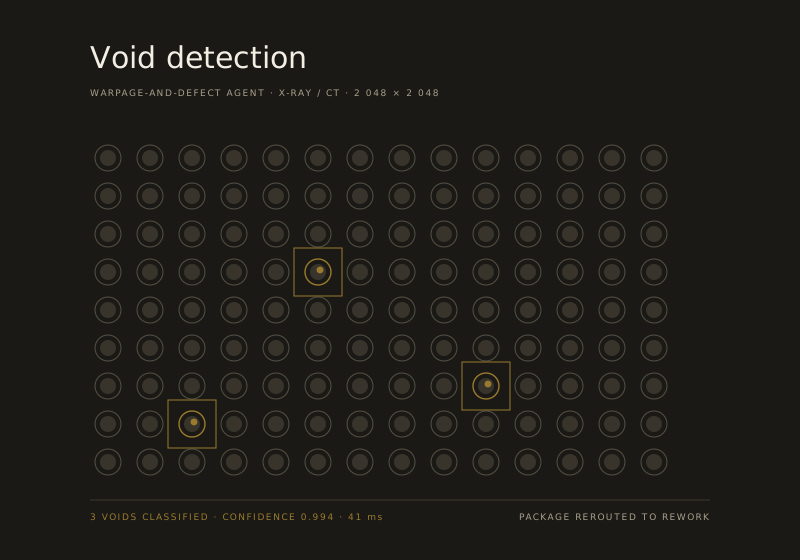
The perception layer for the whole line. It predicts warpage before it happens and classifies voids, bump co-planarity and bridging, die cracks and delamination as they happen — across X-ray and CT, SAM and AOI — feeding both the acting agents and the yield brain.
Agent 07
Yield-and-Ramp
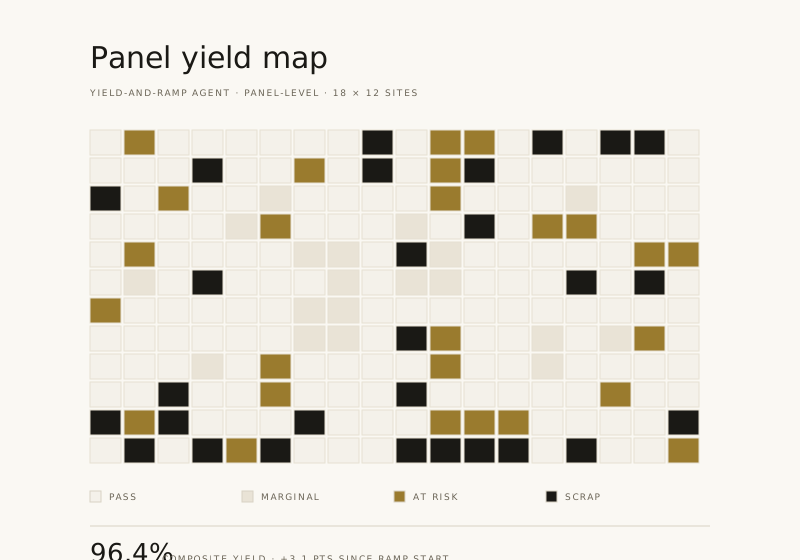
The brain. It fuses defect root-cause, tool health and test results into the decisions that actually move a ramp: which recipe to change, which lot to hold, which DOE to run tonight, which correction to push to every other agent.
How an agent runs
The step contract
Every agent step, no matter which agent, obeys the same four-part contract. That is what makes graduated autonomy governable.
-
Ground the decision
Retrieve the relevant recipe, package spec, design rule and classification standard from the tenant-isolated store. Outputs carry citations; ungrounded outputs are rejected before they reach a tool.
-
Check the envelope
The proposed action is tested against the action envelope your process owners defined — parameter bounds, rate limits, forbidden transitions and the tools it is allowed to touch.
-
Validate in the twin
The move is simulated in the package-and-line twin. If the predicted warpage, void or yield outcome misses spec, the move is re-optimised or escalated rather than executed.
-
Execute idempotently, then verify
The write-back is idempotent and reversible. Inspection and test results verify the outcome, the audit line is sealed, and the delta becomes a training artifact.
Autonomy levels
Four gates, earned in order
No agent starts with authority. It is granted, measured, and revocable.
- L0 — Shadow
- The agent perceives and proposes; nothing reaches a tool. Used to establish the baseline and measure accuracy against your engineers and existing inspection.
- L1 — Advisory
- Proposals surface in the review console with confidence and evidence. An engineer approves each one. Every approval and correction is training signal.
- L2 — Bounded autonomy
- Low-risk moves execute automatically inside approved envelopes with twin pre-validation. Anything outside the envelope escalates. Rollback is automatic.
- L3 — Supervised autonomy
- The agent runs the step; engineers supervise exceptions and periodically re-certify. Autonomy is revoked automatically if measured accuracy drifts below the gate.
Manufacturing operations directorAdvanced packaging, Asia-PacificThe craft is real. Three people in this building can tune a hybrid-bond recipe, and two of them are close to retirement.
Composite drawn from design-partner and industry conversations. Illustrative, not a customer endorsement.
Models
What each agent is actually running
Fine-tuned vision at the edge
Segmentation, detection and anomaly models for X-ray and CT void and warpage, SAM delamination, AOI bump and die-crack, and hybrid-bond alignment metrology — TensorRT-optimised and served on fab-edge GPUs.
- Design target: 8–32 sensor feeds per line [ASPIRATIONAL]
- Design target: sub-100 ms inspection decisions [ASPIRATIONAL]
- Trained per tenant, isolated by construction
Physics-informed process models
Hybrid thermo-mechanical models that combine finite-element-informed warpage priors with machine learning on actual bond, stack, mold, underfill and test outcomes — so the model transfers across package families instead of overfitting one.
- FEA-informed warpage priors
- Time-series prognostics for tool health
- Cross-package-family transfer
Optimisation solvers
Known-good-die sequencing, cassette routing, tool scheduling, re-inspection routing and ramp design-of-experiments, solved as real combinatorial problems rather than heuristics.
- Near-real-time rescheduling on disruption
- Overnight DOE planning for new packages
Frontier reasoning, narrowly used
Frontier models handle packaging-process and defect root-cause reasoning and engineer Q&A, behind a router that sends high-volume steps to fine-tuned open models to control cost of goods.
- Model-agnostic router
- Grounded retrieval with enforced citations
- Continuous evaluation gating in CI
Agent questions
What people want to know
-
Yes — that is the intended path. The Line plan covers one tool or bonder line with one agent’s capability. Most engagements start with warpage and void inspection or hybrid-bonding alignment control, because those carry the clearest ROI.
-
Your process owners do, and only they can widen it. Chipira proposes a starting envelope from your existing recipe bounds; changing it is a governed action with its own approval and audit trail.
-
The orchestrator arbitrates using the twin. If the stacking agent and the bonding agent propose conflicting thermal profiles, both are simulated, the combined outcome is scored against spec, and the conflict escalates if neither combination passes.
-
By default, yes. Your models are trained on your data in your tenant. Cross-fab learning is a separate, contractual, privacy- and IP-preserving mechanism — never a default, never a side effect of using the product.
Start narrow, expand relentlessly
Land one workflow. Own the loop.
A Chipira engagement begins with a single wedge workflow, a shadow-mode baseline and one signed success metric. Everything after that is expansion.