
Solutions by process
The same loop, six different physics problems.
Flip-chip, 2.5D, 3D and HBM, hybrid bonding, fan-out and panel-level packaging fail in different ways. Chipira adapts the agents, the models and the envelope to each — and lands on the workflow that hurts most.
How to read this page
Start where it already hurts
Chipira does not arrive with a transformation programme. It arrives with a wedge: one workflow on one process where the loss is measurable, the baseline is knowable, and the improvement can be signed for.
Below, each process is paired with the wedge workflow we would normally propose, the failure mode it attacks and the metric we would agree to be judged on. If your pain is somewhere else on the flow, the shape of the engagement is the same — only the instrument changes.
Processes
Where Chipira runs
Across IDMs, foundries with back-end operations and OSATs.
- 01 Flip-chip
High-volume mass-reflow and thermocompression flip-chip. Wedge: bump co-planarity, bridging and void detection with closed-loop bond control. Judged on escape rate and bond yield.
- 02 2.5D / CoWoS-class
Chip-on-wafer-on-substrate and interposer-based integration where capacity gates the entire AI accelerator supply. Wedge: warpage prediction and placement control on the interposer. Judged on yield points and scrap of known-good die.
- 03 3D / HBM stacking
Twelve-high and beyond DRAM stacks over a logic base die, joined through thousands of TSVs. Wedge: known-good-die sequencing and stack-order optimisation. Judged on known-good-die loss and stack yield.
- 04 Hybrid bonding
Copper-pad-to-copper-pad joining at sub-micron alignment with zero particle tolerance. Wedge: alignment drift control and particle flagging. Judged on alignment excursions and bond yield.
- 05 Fan-out and panel-level
Reconstituted wafer and panel processing where warpage scales with area and one bad panel is an expensive afternoon. Wedge: warpage sensing and molding/underfill control. Judged on panel scrap and composite yield.
- 06 Test and binning
Final and system-level test where the build record and the result finally meet. Wedge: root-cause attribution from bin signature back to bond and stack. Judged on time-to-root-cause and re-test rate.
Failure modes
What actually destroys packages
Warpage
Drifts with material lot, temperature and panel; scales with area; and reveals itself late, after the package has already accumulated its full value.
Voids
Under bumps and in the bond line, invisible until X-ray or CT — and by then the die beneath is already spent.
Misalignment
On a hybrid bond, a fraction of a micron of drift or a few thousandths of a degree of rotation is the difference between a module and scrap.
Die cracks and chip-outs
Introduced by handling, thermal shock or bond force, and often carried silently into a stack where they take the whole stack down.
Delamination
Interface separation that passes final test and fails in the field — the most expensive class of escape a packaging house can produce.
Particles
On a hybrid-bonding surface, a single particle is a defect. The process window is cleanliness, and cleanliness is a control problem.
The ramp problem
Every new package starts at the bottom of the curve
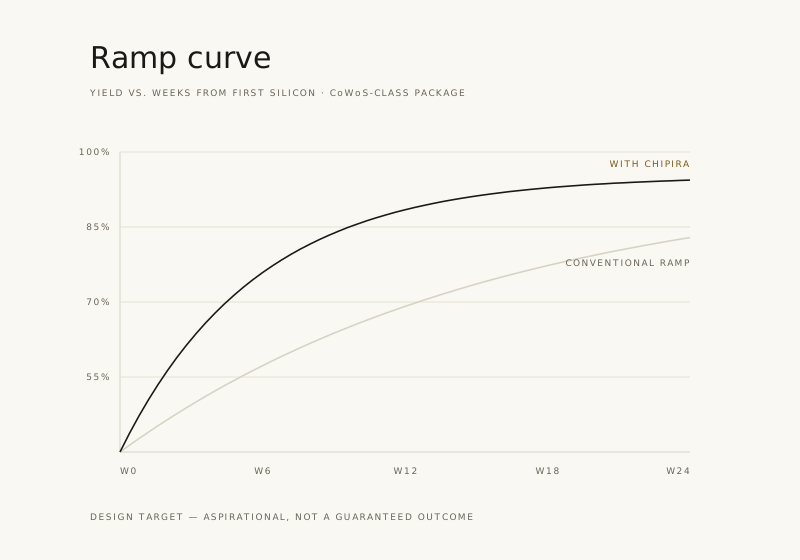
New nodes and new package designs traditionally take quarters of manual tuning to reach target yield — during which the most capacity-constrained step in the industry runs below its potential.
The engagement
How a wedge is run
-
Scope one workflow
We pick the single workflow with the clearest measurable loss on your highest-value package, and agree what would count as success before anything is installed.
-
Instrument and baseline
Chipira runs in shadow mode for a defined period, producing a measured baseline of classification accuracy, yield, scrap and ramp against your current practice.
-
Prove in assist mode
The agent proposes; your engineer approves. Accuracy is measured against the engineer plus the existing inspection baseline until the agreed gate is cleared.
-
Convert and expand
When the signed metric is met, the pilot converts to a paid Line or Fab contract, and the adjacent module on the same package flow comes online.
Packaging process integration managerFoundry back-end operationsWe do not have a data problem. We have twelve data problems that never meet.
Composite drawn from design-partner and industry conversations. Illustrative, not a customer endorsement.
Qualifying
When this works — and when it does not
We would rather disqualify early than run a pilot that cannot produce a number.
- Good fit
- Sufficient package volume and value to make ROI unambiguous — high-value AI accelerator, HBM or HPC packages are ideal.
- Good fit
- Existing bonders, molding, X-ray/SAM/AOI, test and MES with SECS-GEM or API access, and an organisation willing to grant it.
- Good fit
- An executive mandate to raise yield, accelerate a ramp or cut warpage and void scrap — and willingness to sign a pilot success metric.
- Poor fit
- R&D-only or pilot-line-only operations with no volume production. There is no baseline to beat and no economics to prove.
- Poor fit
- Sites that cannot integrate back-end tools under their IP and security constraints. We would rather say so than sell around it.
- Poor fit
- Buyers looking for a horizontal dashboard. Chipira is a system of action; if nothing may be written back, most of the value is unavailable.
What we are judged on
The metrics that end up in the contract
- Yield Composite and step yield on the target package family, measured against the shadow-mode baseline.
- Scrap Warpage and void scrap, and known-good-die loss — the most expensive material in the building.
- Ramp Weeks from first silicon to target yield on a new package design or node.
- Accuracy Defect classification accuracy against the engineer plus existing X-ray, SAM and AOI baseline.
The specific metric, target and measurement method are agreed in writing before a pilot begins.
Process questions
Fit and scope
-
On the one where a single point of yield is worth the most — which, for most fabs today, means the CoWoS-class or HBM flow. The wedge should be chosen by economics, not by technical curiosity.
-
The perception models transfer well because defect physics does; the control models are tuned to your line during shadow and assist mode. Physics-informed priors are what let us start from something better than zero without ever needing to see another fab’s recipes.
-
Yes — that is the strongest case for the twin. New package designs are where manual tuning costs the most quarters, and where a simulated starting recipe has the most headroom to remove.
-
Where it helps a mutual customer, yes. Vendor-neutral does not mean vendor-hostile; embedded distribution through bonder, inspection and test OEMs is an explicit part of our strategy.
Start narrow, expand relentlessly
Land one workflow. Own the loop.
A Chipira engagement begins with a single wedge workflow, a shadow-mode baseline and one signed success metric. Everything after that is expansion.