Features
Everything the line needs done, done.
Not a feature list assembled to fill a comparison grid. This is the set of things that must happen on an advanced-packaging line between a diced wafer and a binned module.
Perception
Seeing the package properly
One perception layer across every instrument on the line, instead of five vendors’ thresholds arguing with each other.
- 01 X-ray and CT void detection
Volumetric void, head-in-pillow and non-wet detection under bumps and in the bond line, classified with confidence and evidence rather than a pass/fail threshold.
- 02 Warpage sensing and prediction
Real-time warpage measurement plus prediction — warpage is forecast from material lot, panel history and thermal profile before the package reaches the step that will reveal it.
- 03 SAM delamination mapping
Scanning-acoustic delamination and interface-defect maps registered to the package layout, so a finding is attributed to a layer and a process step, not a coordinate.
- 04 AOI bump and die inspection
Bump co-planarity, bridging, missing and deformed bumps, die cracks and chip-outs, at line rate on the AOI stream.
- 05 Hybrid-bond alignment metrology
Sub-micron placement and rotation offsets tracked continuously, with drift detected and corrected before it crosses the specification limit.
- 06 Particle and contamination flagging
Detection of the particulate and surface conditions that quietly destroy a hybrid bond, escalated to handling and cleaning before the bond is attempted.
Control
Acting on the process
Perception without write-back is a report. These are the actions Chipira takes on the line.
- 01 Closed-loop bond control
Placement, bond force, thermal profile and alignment corrected in-loop inside your action envelope, with fail-safe stop rather than a bond the agent cannot vouch for.
- 02 Stack and TSV sequencing
Known-good-die ordering, stack sequencing and TSV planning optimised against yield expectation, not against the order the dies happened to arrive in.
- 03 Mold and underfill control
Flow, cure and pressure controlled to eliminate voids and residual warpage — the two failure modes that most often surface only after the package is complete.
- 04 Robotic handling and logistics
Die, substrate and panel handling and cassette routing driven directly, keeping mishandling and particles out of the process window.
- 05 Test routing and binning
Final and system-level test routed and binned with knowledge of what was actually bonded, closing the loop between build and result.
- 06 Rework and scrap disposition
Automatic, auditable disposition of at-risk packages to rework, re-inspection or scrap — before more value is added to a package that will not survive.
Intelligence
The part that compounds
Yield and ramp
Root cause, not correlation
Defect signatures, tool health, recipe history and test results are fused into a root cause with an owner and an action — and the same fusion drives ramp: which DOE to run, which lot to hold, which recipe to change tonight.
Read about Yieldra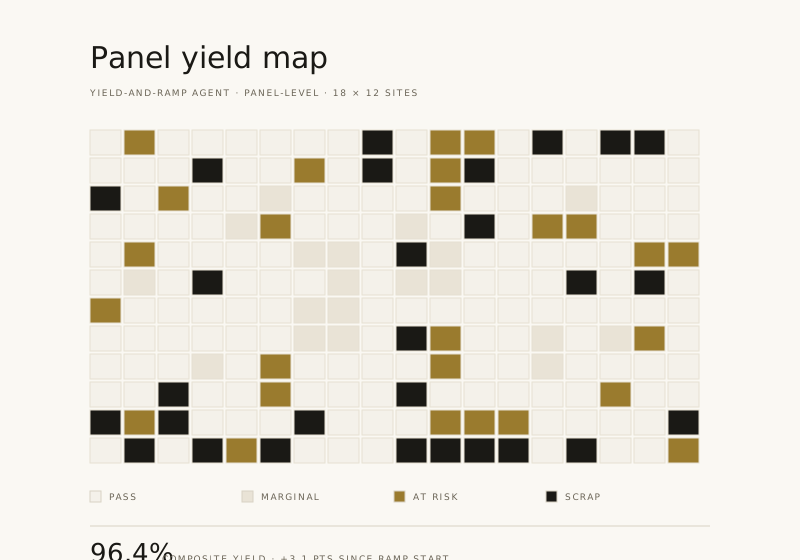
Ramp acceleration
The curve is the product
A new 2.5D, 3D or hybrid-bonding package traditionally ramps over quarters of manual tuning. Chipira attacks the curve directly: twin-optimised starting recipes, automated DOE, and corrections applied the shift they are learned rather than the quarter.
See the wedge workflows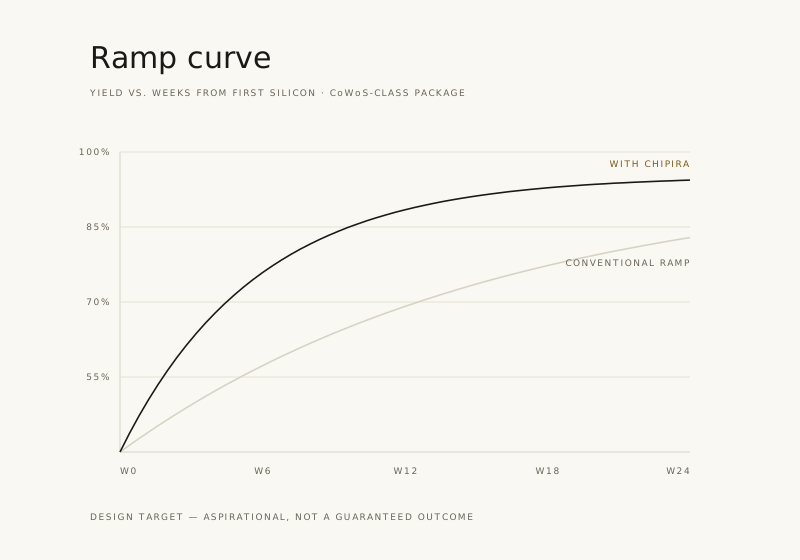
Integration
What we connect to
Read everywhere. Write where you allow it.
- Die bonders and aligners
- Die-attach, flip-chip and hybrid-bonding tools — placement, force, thermal profile, alignment metrology; write-back of setpoints and corrections.
- Molding and underfill
- Molding presses, underfill dispensers and cure ovens — flow, pressure, temperature and cure profile.
- Inspection and metrology
- X-ray and CT, scanning acoustic microscopy, AOI and warpage metrology — image, volume and measurement streams at line rate.
- Test and system-level test
- Final test and SLT cells — results, bins and failure signatures joined back to the build record.
- MES and yield systems
- Lot, route, recipe and yield context over SECS-GEM and APIs, so agent actions are expressed in your fab’s own vocabulary.
- Identity and workflow
- SSO and RBAC, ticketing and notification surfaces, so approvals and escalations land where your engineers already work.
Governance
The features nobody demos, and everybody needs
Immutable audit trail
Every perception, proposal, approval, write-back, exception and rollback recorded in a tamper-evident, yield-grade log — attributable to an agent, a model version and a person.
Action envelopes
Versioned, reviewable bounds owned by your process engineers. Chipira cannot act outside them, and widening one is itself an approved, audited action.
Graduated autonomy
Four gates from shadow to supervised autonomy, each opened by measured accuracy and revoked automatically if accuracy drifts.
Grounded outputs
Retrieval over your recipes, specs, design rules and classification standards with enforced citations. An answer without a source does not ship.
Per-tenant isolation
Data, retrieval, memory and fine-tuned models scoped per tenant. Cross-fab learning is contractual and opt-in, never a side effect.
On-premise and air-gap
Full fab-edge deployment with a private or on-site control plane, and an air-gapped configuration for the most sensitive lines.
Operations managerOSAT, high-volume flip-chipThe demo is the easy part. Tell me what happens on the shift when it is wrong at three in the morning.
Composite drawn from design-partner and industry conversations. Illustrative, not a customer endorsement.
Coverage
Features by plan
Land on one workflow. Expand across the loop.
| Capability | Line | Fab | Enterprise |
|---|---|---|---|
| One agent on one tool or line | Included | Included | Included |
| Full seven-agent loop | — | Included | Included |
| Package-and-line twin | — | Included | Included |
| Custom process, defect and yield models | — | — | Included |
| Fab-edge fleet management | — | Single line | Multi-fab |
| Immutable audit trail | Included | Included | Included |
| On-premise / air-gapped | On request | Included | Included |
| Outcome-based pricing components | — | Available | Available |
Scope questions
What is not here yet
-
No. Full autonomy across an entire line is the destination, not the starting product. Today the honest scope is one wedge workflow taken to bounded autonomy, with adjacent modules added after the metric is met.
-
Not yet. The connector library covers the major bonder, molding, inspection, test and MES classes and grows with each design partner. Long-tail integrations beyond design-partner stacks are explicitly out of scope for the first release.
-
No, and deliberately so. A packaging line is not a product you should be able to point an agent at with a credit card. Engagements are sales-assisted and scoped with your process and quality owners.
-
Fan-out and panel-level packaging are in scope for the platform today. Co-packaged optics is on the longer-range roadmap as the adjacent scope after 3D and hybrid bonding mature.
Start narrow, expand relentlessly
Land one workflow. Own the loop.
A Chipira engagement begins with a single wedge workflow, a shadow-mode baseline and one signed success metric. Everything after that is expansion.