Partners
Vendor-neutral is not the same as alone.
Chipira is deliberately neutral across tool vendors — and deliberately close to them. The fastest path to autonomy on a packaging line runs through the companies that already built it.
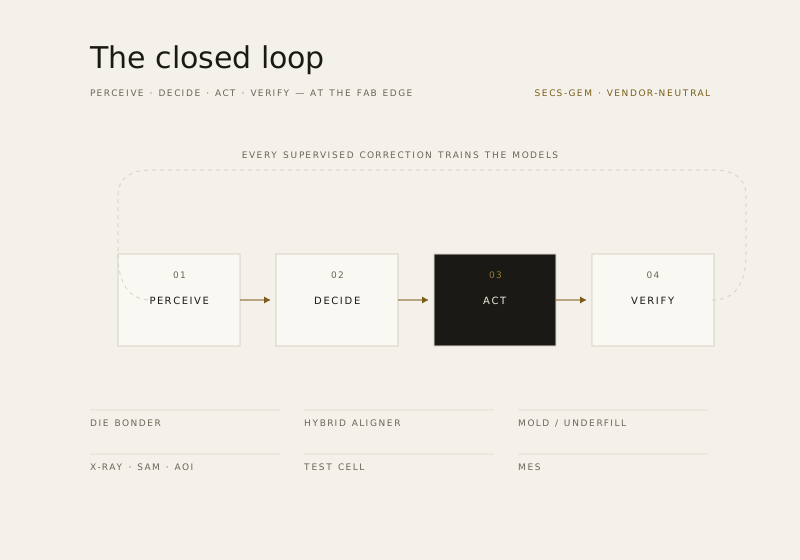
Connector coverage across the back end
- ASMPT
- BESI
- Kulicke & Soffa
- EV Group
- SUSS MicroTec
- TOWA
- Nordson
- Camtek
- Onto Innovation
- Advantest
- Teradyne
- Cohu
Vendor-neutral integration over SECS-GEM, tool APIs and OT interfaces. Vendors listed are integration targets for the connector library and are not endorsements or commercial partnerships.
Partnership types
Four ways we work together
Equipment OEMs
Bonder, hybrid-bonding aligner, molding and underfill, X-ray and CT, SAM, AOI and test vendors. Chipira-ready autonomy shipping with the tool, over SECS-GEM, is the fastest distribution either of us has.
- Joint connector certification
- Co-sell into shared accounts
- Embedded autonomy on the tool
OSATs, IDMs and foundries
Beyond being customers, packaging houses shape the connector library and the review console. Design partners set the specification for the product they will run.
- Design-partner programme
- Roadmap influence
- Reference and case-study rights
Integrators and advisors
Automation integrators and manufacturing consultancies who already hold the change-control relationship inside a fab and can deliver a deployment at scale.
- Delivery enablement
- Scoping and qualification support
- Shared success metrics
Compute and model platforms
Accelerated-computing, cloud and frontier-model platforms whose roadmaps determine what is possible at the fab edge next year rather than in five.
- Edge and training hardware
- Model access and co-marketing
- Early roadmap visibility
The OEM case
Why a tool vendor should want this
An equipment vendor’s software can only ever see its own tool. That is not a failure of ambition; it is a structural limit. The most valuable decisions in advanced packaging depend on data from instruments the tool vendor did not build and cannot access.
Chipira does not compete for that ground. We do not sell bonders, molding tools, inspection systems or testers, and we never will. What we do is make a vendor’s tool more capable in a mixed-vendor line by giving it context it cannot obtain alone — and making its performance visible in the yield outcome.
For a vendor, a certified Chipira connector means the tool arrives autonomy-ready in a line the vendor does not fully own. For the fab, it means the integration work is already done. That is a distribution channel for both of us.
- We will never sell a bonder, a molding tool, an inspection system or a tester
- Connector certification is jointly specified and jointly maintained
- Yield outcomes are attributable, which favours the tool that performs
- Co-sell motion into shared accounts with a shared success metric
How it works
From conversation to certified connector
-
Scope the interface
We agree the tool classes, the SECS-GEM or API surface, the telemetry available, and — critically — what may be written back and under what conditions.
-
Build and validate
The connector is built against the tool, validated on a real or reference unit, and characterised for latency, reliability and failure behaviour.
-
Certify jointly
Both organisations sign off the connector, including the fail-safe behaviour and the action envelope defaults. This is the artifact a fab’s change-control board will read.
-
Deploy and co-sell
The certified connector ships with the tool or is enabled on installed base, and both teams work the shared account with one agreed success metric.
What we bring
Partner commitments
- Neutrality
- We do not favour a vendor in agent behaviour, and we do not use one partner’s telemetry to advantage another. Neutrality is the product; compromising it would end it.
- Engineering
- A named engineer on the connector, a documented interface specification, and a maintenance commitment across tool firmware revisions.
- Joint enablement
- Technical and commercial enablement for your field teams, including the qualification protocol a fab will run.
- Shared measurement
- One agreed success metric per shared account, visible to both organisations, with the audit trail as the source of truth.
- Honest positioning
- We will not describe a partnership as deeper than it is. Vendors listed as connector targets on this site are described as exactly that.
Product directorBack-end equipment vendorOur software cannot see the X-ray. Their software cannot move our stage. Somebody has to bridge that.
Composite drawn from design-partner and industry conversations. Illustrative, not a customer endorsement.
Channel
Why distribution matters here
- 12+ Tool classes in a typical advanced-packaging line, from a dozen different vendors.
- 1 Number of them that can see the whole package flow today.
- SECS-GEM The common interface that makes vendor-neutral integration tractable at all.
- Shared Every partner engagement runs against one success metric visible to both sides.
Partner questions
What vendors ask first
-
No. Chipira does not build or sell hardware, and the moment we did, our neutrality — and therefore our product — would be worthless. We are a software layer above the tools, permanently.
-
In a co-sell, whoever the customer says owns it. In practice the tool vendor usually holds the account and we hold the workflow; the success metric is shared regardless.
-
No. Tenant isolation applies to partner data as it does to customer data. Cross-tenant learning requires explicit contracts with the data owner, and a competitor’s tool never benefits from your telemetry.
-
It depends almost entirely on the interface maturity. A tool with a well-implemented SECS-GEM surface is measured in weeks; a closed or partially documented tool is a longer conversation about what is possible at all.
Partnerships
Build the layer with us.
If you make a tool on an advanced-packaging line, integrate them for a living, or supply the compute that makes fab-edge inference possible, we should talk.